
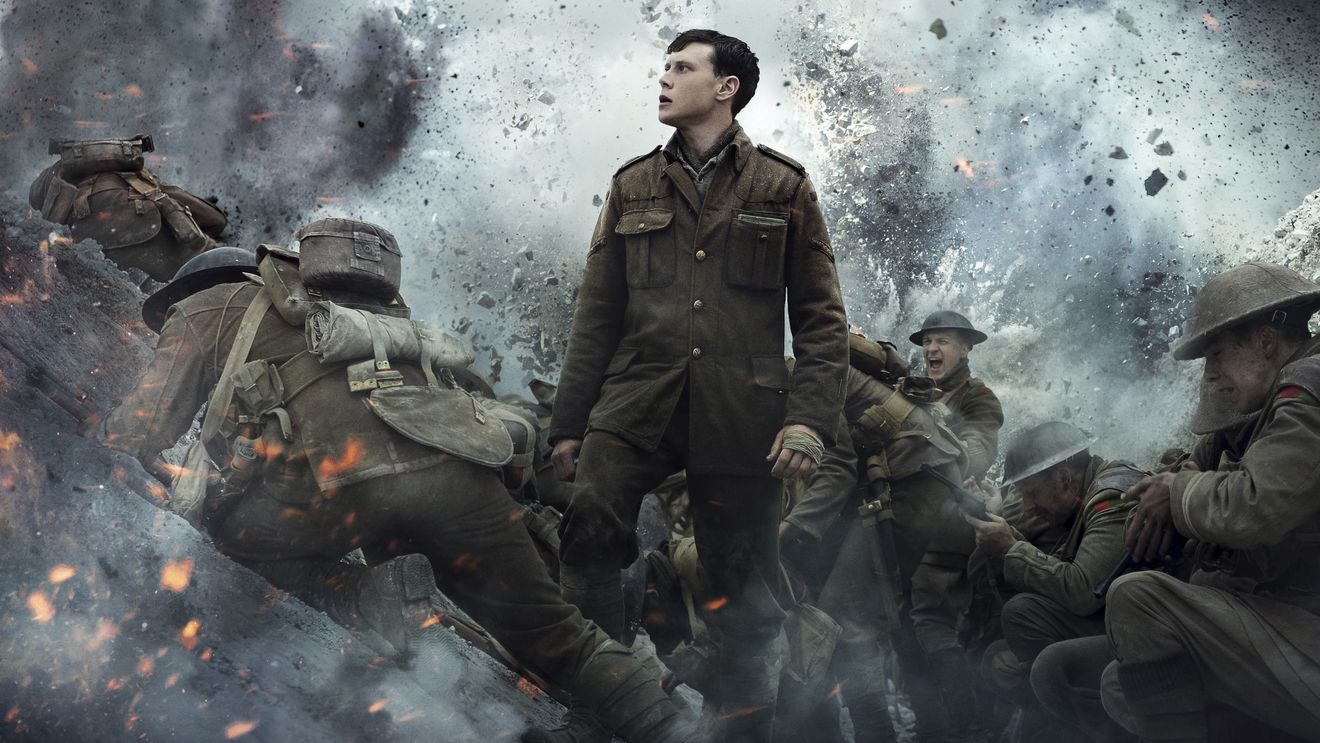
1917 takes place during World War One and depicts the journey of two young soldiers, Blake and Schofield, tasked with delivering a message to the second battalion before dawn, lest they walk into a trap that will end in mass slaughter. While its premise is simple, the film has attracted widespread media attention for its innovative cinematography, as it is styled as a single continuous shot. The question of whether 1917 is a good film depends on whether we view this decision as supporting the narrative, or as a gimmick to veil a thin story.
The use of a continuous shot is effective in that it imbues every sequence of 1917 with a sense of tension and urgency. The camera never cuts away from the protagonists and therefore the audience has no reprieve from the impending deadline. A testament to the power of this technique is the immense anxiety I felt whenever the soldiers stopped moving.
The continuous shot is also highly immersive. It powerfully conveys the grueling relentlessness of war as it requires the audience bear witness to every step of the soldiers’ journey, with all of the horror, idleness and fear that this entails. Further, in choosing to restrict the film’s scope to these particular young, low-level soldiers while using a wide-angle lens that emphasises the immensity of their environment, we begin to comprehend the overwhelming nature of World War One.

In spite of the attention paid to visual details, 1917 neglects to engage in character development, preferring to use its characters as symbols that service the broader themes of the film. As a result, it is nigh on impossible to form an emotional connection to them. The two protagonists appear to represent the conflict between idealism and disillusionment in the discourse surrounding WW1. Blake represents idealism – he attributes value to medals, respects his orders and has a strong conviction they will succeed in their mission. There is a scene where the two young soldiers come across a field of cherry trees that have been chopped down by the German army. Blake points out that the seeds will fall and spread, causing the orchard to become more fruitful for the devastation that has been wrought upon it. While this scene highlights Blake’s idealism, the metaphor here is so contrived that it was embarrassing to watch.
Meanwhile, Schofield represents realism. He regards medals as “pieces of tin” and swaps his for a bottle of wine. His growing disillusionment is evident when he says “this isn’t even our country”, acknowledging the apparent futility of their involvement in the war. While characterising Blake and Schofield in this manner makes clear the themes of 1917, it renders them mere vehicles for metaphor instead of fully realised characters.
I get the impression that 1917 leans heavily into metaphor as it wishes to be regarded as an important film; however, this intentional grasp for significance causes the film to feel inauthentic. This was evident in Benedict Cumberbatch’s performance as Colonel MacKenzie, whose dialogue feels desperate to be quoted:
“I hoped today might be a good day. Hope is a dangerous thing.”
“There is only one way this war ends. Last man standing”.
Instead of attaining the sought after significance, the lines come across as cheap clichés and verge on parody.
1917’s wish to be considered important extends to a stilted scene wherein Schofield meets a French woman and her baby hiding amongst the rubble of war. It is difficult to comprehend why such a scene was considered necessary in the context of this film. I surmise that it was an attempt at acknowledging the impact of the war on the French people and covering all bases of cultural representation. It’s a shame that this seems to have been the same decision made in every other war movie, thereby making the scene come across as derivative and pandering.
The most gripping aspect of 1917 is Andrew Scott’s performance as Lieutenant Leslie, which was a refreshing source of authenticity and emotional intensity. Leslie is responsible for guiding Blake and Schofield out of the trenches and does not hide his bemusement at the absurdity of their undertaking. In his one minute of screen time, Scott conveys frustration, despair, compassion and amusement at the insipid orders that have been issued. He embodies the multitude and conflicting perspectives on WW1, which is historically considered to have been a war about nothing in which a generation was “slaughtered in stupid battles planned by stupid generals”. I would like to have seen a version of 1917 that focused less on constructing stunning visuals and instead leaned into drawing out authentic performances such as that given by Scott. I imagine that this would not only have been more cost-effective (the film’s budget was $100 million dollars), but would also have imbued the film with greater meaning and power.
1917 is a fine film. While the novel decision to use a continuous shot is visually interesting and supports storytelling in some respects, the film lacks depth. Accordingly, 1917 cannot withstand repeat viewings and is ultimately an inconsequential piece of momentary intrigue. For this reason, it is concerning that 1917 was awarded the Golden Globe for best drama. If awards are indeed a reflection of what we value in cinema, it would appear we are moving towards a media landscape rife with costly stunts and empty platitudes.
Werner Herzog once remarked that:
“some directors use flashy tricks because they know the material isn’t strong enough to sustain a passive camera. It’s a giveaway that I’m watching an empty film.”
Such was my experience of watching 1917.
 View Kid