
Of all the things that could have convinced me to become a vegetarian, I never expected it would be the tale of a grossly anthropomorphised super pig. Such is life under the influence of Bong Joon-Ho, a modern master of science fiction.
Okja is premised on the alleged discovery of a new breed of pig by the Mirando Corporation, a multi-national meat conglomerate in a much-needed phase of re-branding. To promote this new product, Mirando engages 26 farmers from around the world in a competition to raise the best super pig within 10 years. One such pig is Okja, who is raised lovingly by a South Korean farmer and his daughter, Mija. In fact, they raise Okja so well that Mirando takes an unfortunate interest in her when the 10-year mark arrives. What follows is a dark journey through the ugliness of the livestock industry as seen through the eyes of Okja, while Mija follows determinedly in her wake, the horror of it all made worse by her incomprehension.

I tend to be resistant to movies that have a clear social or political agenda; however, there was a playfulness and self-awareness to Okja that superseded my usual gripes. In his titular super pig, Bong Joon Ho has constructed a sympathy machine fitted with expressive human eyes, a communicative voice, uncanny intelligence and bucketfuls of empathy. She can even cry for god’s sake. Such hamminess would usually provoke eye rolling and disengagement, but through his incredible style and commitment to leaning into absurdity, Bong Joon Ho instead transports us to a childlike state of mind where we want to believe that animals have feelings too. This has the dual effect of making us fall in love with Okja and causing us greater pain once the film’s nightmarish second act rolls around.
Bong Joon Ho succeeds in making Okja digestible by conveying an awareness of the flaws of animal advocacy groups, thereby avoiding the preachy tone that is a disaster for films like this. The Animal Liberation Front (“ALF”) that seeks to reveal the cruel practices of organisations like Mirando is depicted as overly sensitive and ironically self-righteous, without ever being degraded. This is helped by a good sprinkling of kitsch and twee – rose petal bombs included- which renders the group endearingly eccentric. The depiction of ALF reflects one of Bong Joon Ho’s greatest strengths – he grants every character in his narrative worlds a sense of depth; even his secondary characters have idiosyncrasies.
Mija embodies the South Korean comic hero. She is small yet powerful, incredibly tenacious, stubborn and eccentric. In this respect, she is very similar to Do Bong Soon, the protagonist of Strong Girl Bong Soon. Overall, Okja shares a quality prevalent in South Korean films and TV, in that it extends our willing suspension of disbelief to incredible lengths. The directors and screenwriters who work in this space seem to lack the hesitance to work in a realm that is slightly outside of reality, allowing them to create truly unique films.

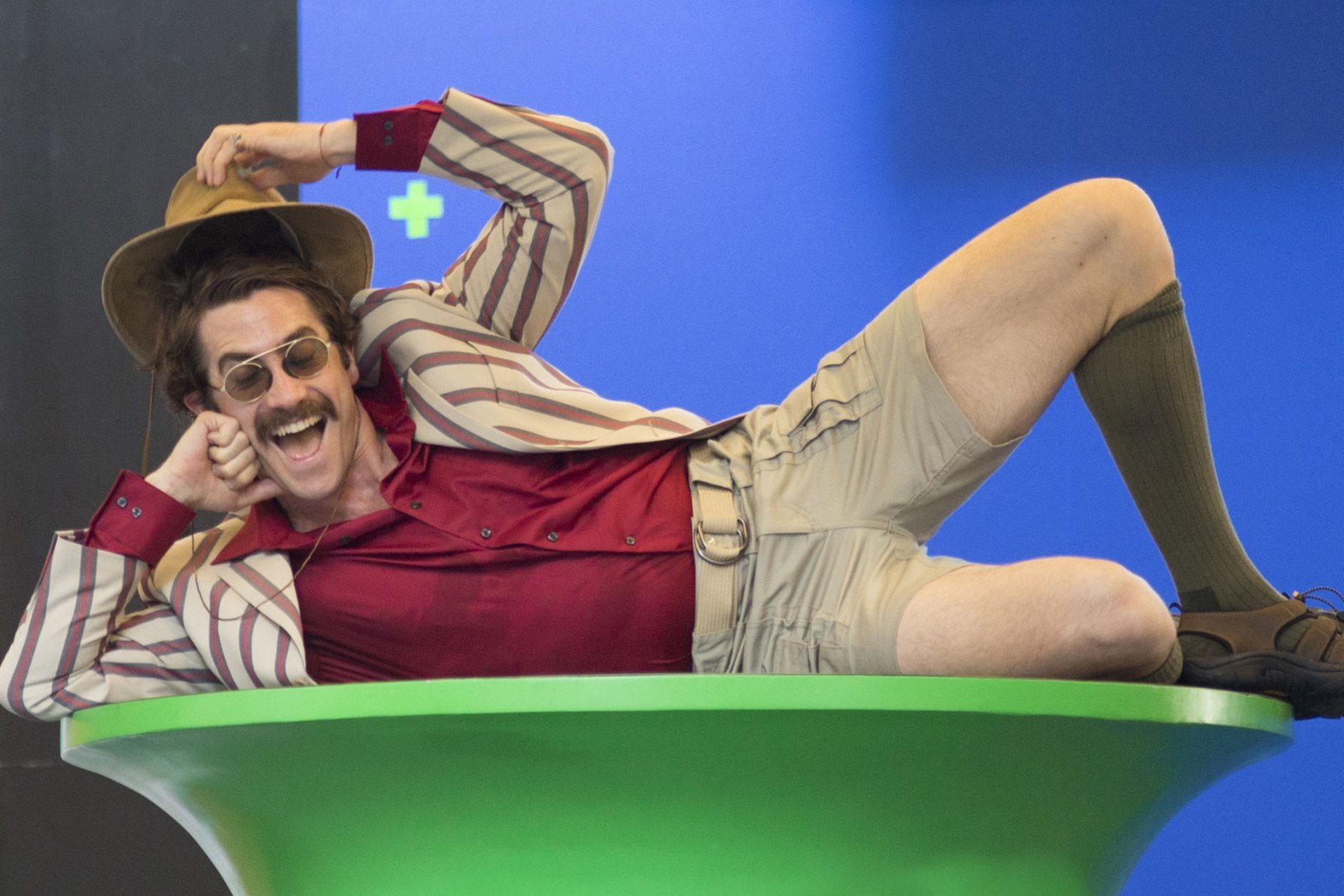
In Okja, Jake Gyllenhaal once again displays a penchant for acting completely insane. Here he portrays Dr Johnny Wilcox, a zoologist whose fading relevance threatens his position as the public face of the Mirando corporation. Wilcox is a classic shit heel and antagonises the audience to the extent that many wish he wasn’t even in the film. However, as I see it, the hostility he evokes is merely a testament to his success as an antagonist.
One of the most memorable images in Okja is the opening sequence, wherein Lucy Mirando is pitching the super pig project to an intrigued audience. While her presentation is kitschy and delightful, we can see Giancarlo Esposito circling the shadowy rafters above like a malicious shark. It is clear that he has orchestrated the event and is revelling in its success. This encapsulates the layers of light and dark that are at play in Okja.
In the end, Bong Joon Ho pulls out of what feels like a nose-dive into deep tragedy, while never allowing us to forget what we saw on the way down.
 View Kid