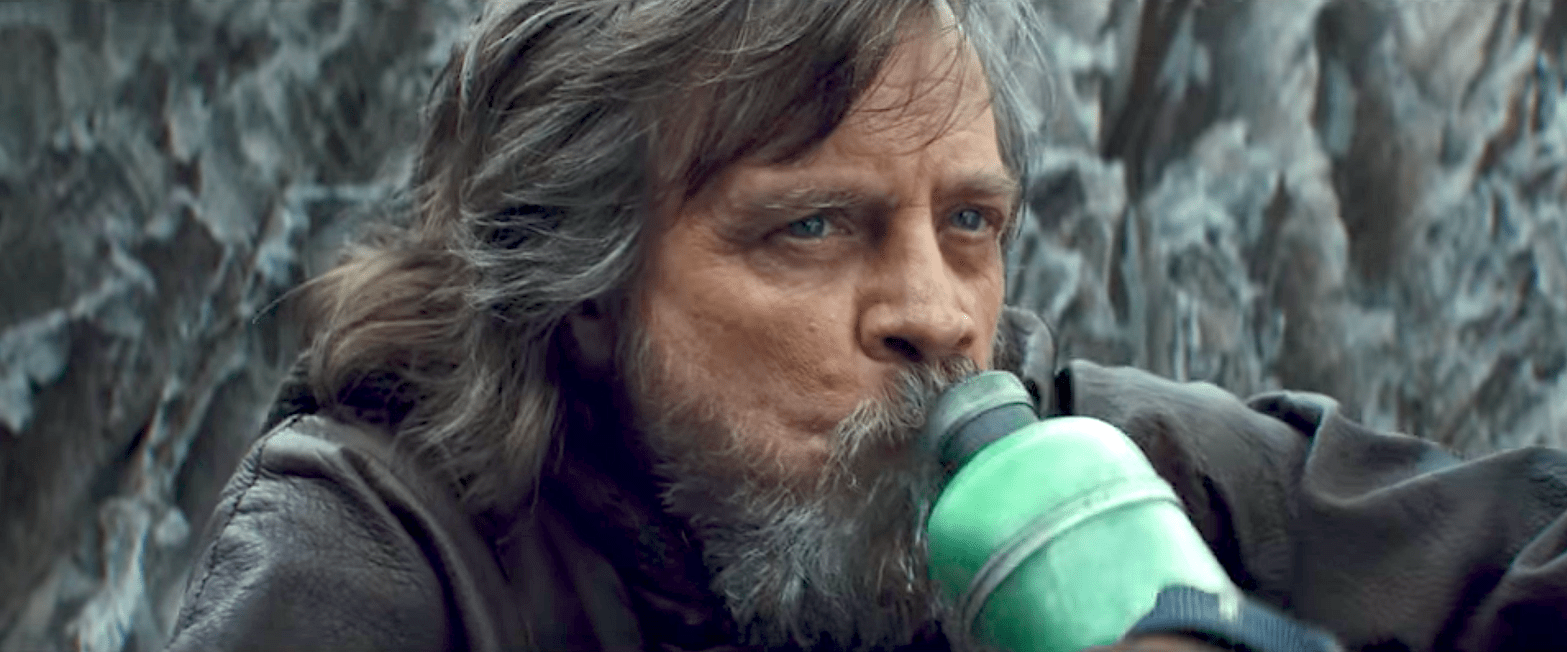
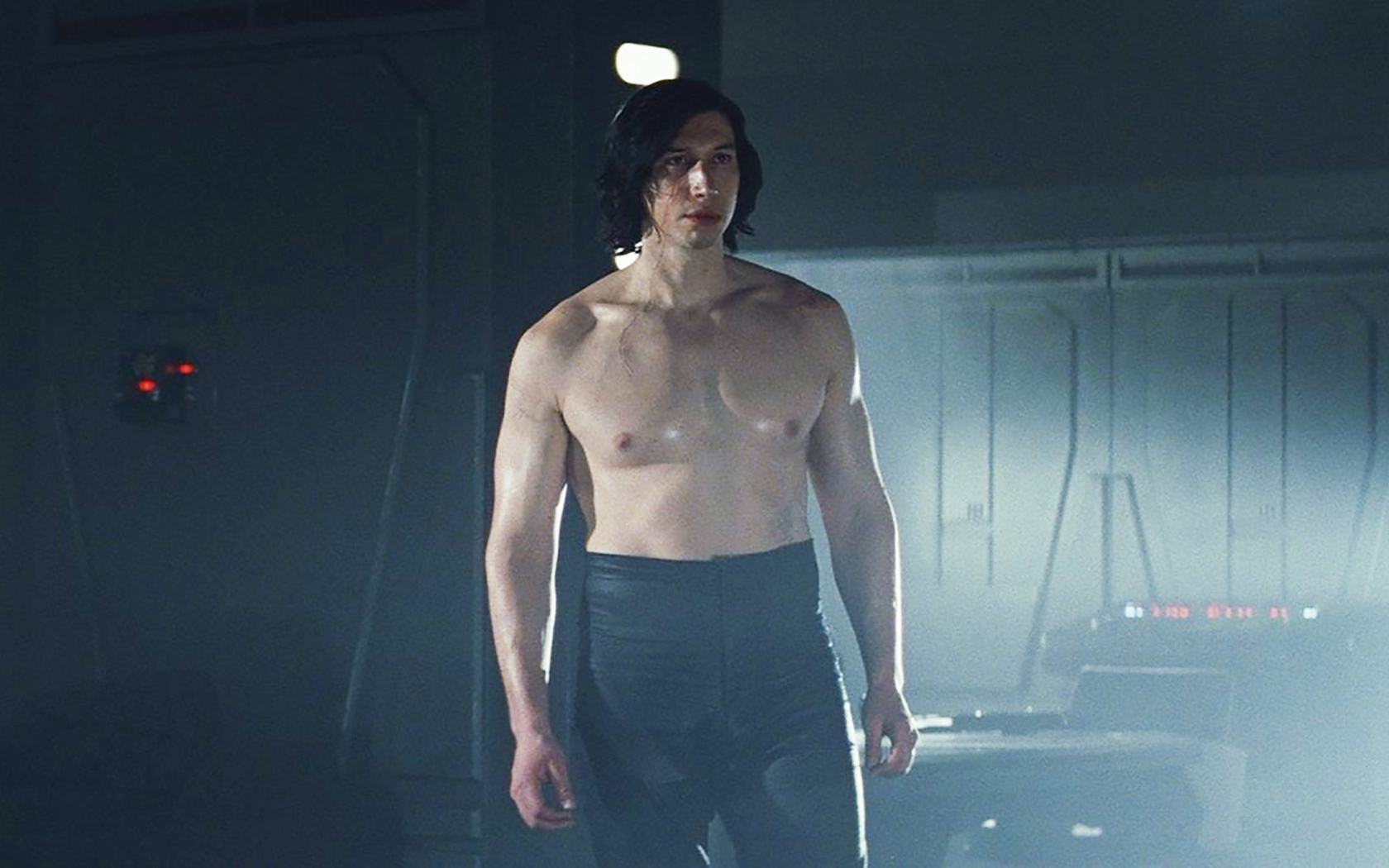
The Last Jedi indulges its audience in a wealth of rich imagery, the most distinct of which is a tie between the unexpectedly sensual reveal of Kylo Ren’s tree trunk of a shirtless torso, and the unexpectedly disturbing image of Luke Skywalker’s green-milk-encrusted beard following his molestation of a sea cow.
These scenes speak to the heart of The Last Jedi, which is founded on the whimsical and borderline-absurd aspect of the Star Wars universe. Many have taken issue with the film for that very reason; however, its lightheartedness feels true to the spirit of the original trilogy. Let us not forget that George Lucas is the man who created Jar Jar Binks. In The Last Jedi, Rian Johnson successfully tears Star Wars from the clutches of militant fans who demand this series of films about space people with magical powers be ‘realistic’. In so doing, he is granted creative liberty and the freedom to take some welcome risks with this narrative.
Mark Hamill publicly voiced discontent with Luke Skywalker’s trajectory in The Last Jedi, and there is legitimacy to his suggestion that the disillusioned old man depicted here is inconsistent with Luke’s initial character development. In the original trilogy, Luke was able to conceive of redemption for Darth Vader despite years of witnessing his morally corrupt behaviour. It is thus surprising that Luke’s faith in Kylo Ren would falter to the extent that he considers murdering his protegee. Whilst this serves as a lesson that our idols don’t always live up to our expectations, Luke Skywalker may not be the most appropriate conduit for such a message. It is devastating to witness a character who once embodied hope fall prey to cynicism and fear.
That being said, Hamill does everything in his power to realise Rian Johnson’s vision of Luke Skywalker. Angry Luke Skywalker is a mood. He exudes ‘destroyed by life’ energy and is exhausted by the mere suggestion that he help the Resistance in the fight against the First Order. At the beginning of the film, when Rey passes Luke his old lightsaber and he proceeds to toss it off the cliff behind him, this nicely foreshadows how this character – and in fact the entire film – will subvert our expectations.
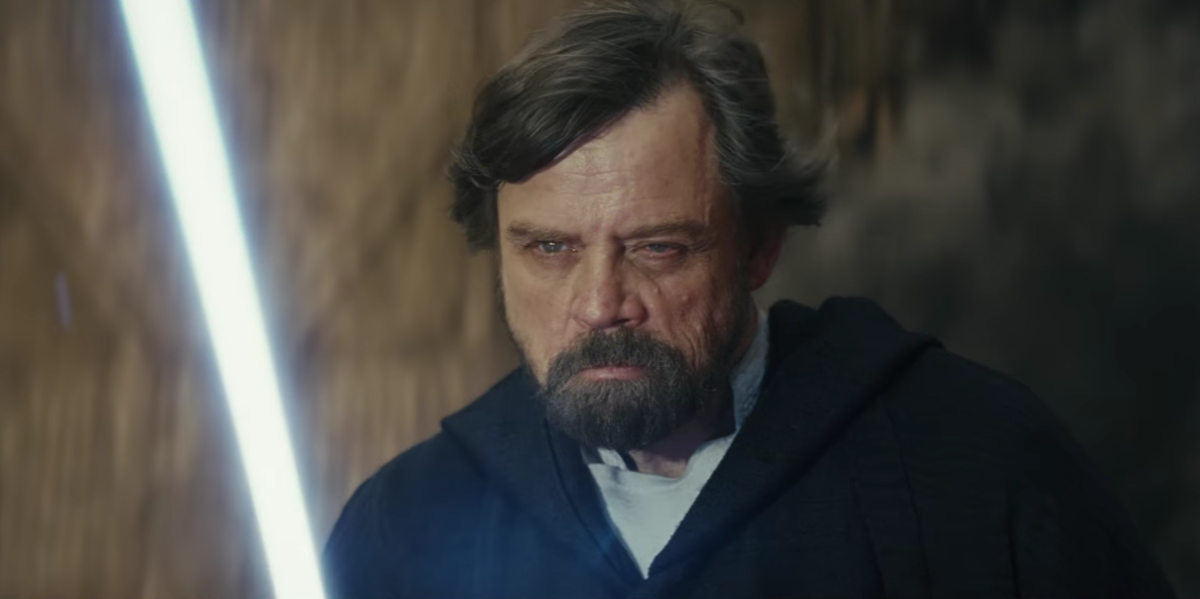
While Luke fails to nurture Rey as anticipated, Kylo Ren unexpectedly comes to fulfill this role through their force connection. The force connection between Kylo and Rey is the masterstroke of the new trilogy and differentiates it from the films that have come before. The Last Jedi provides no sage master to offer guidance; instead, two damaged adolescents must try to support one another after being let down by the people who were supposed to look after them.
Rian Johnson has said that Kylo Ren was the character he was most excited to “get into and write for” when he took on this project and this is reflected in his attention to Kylo’s development. Kylo is not only permitted to be more complex than a simple villain, he is elevated to being a second protagonist.
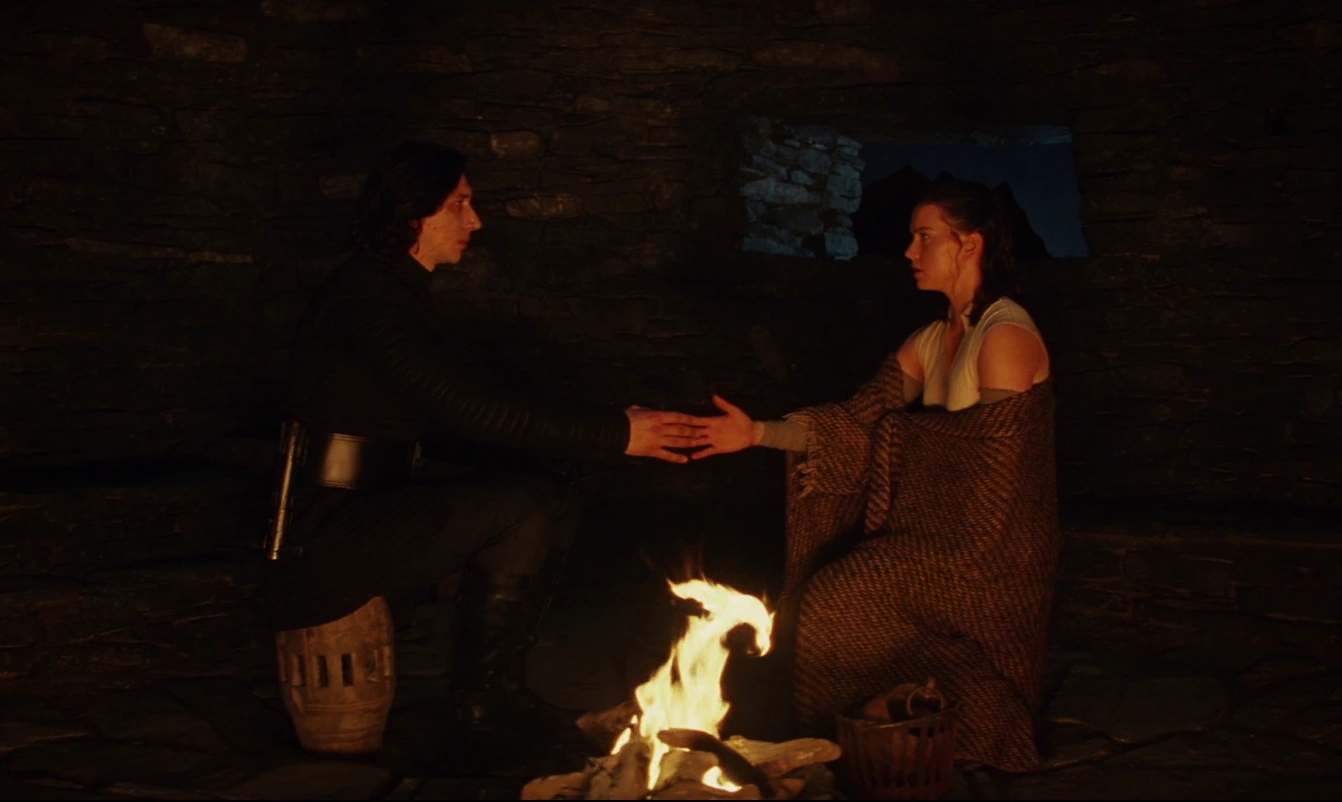
The duality of protagonists is encapsulated in the visually arresting fight sequence in Supreme Leader Snoke’s throne room. This is a great vehicle for presenting the immense combined power of Kylo and Rey and their natural chemistry in combat. It also foreshadows the prophesied force dyad that we will come to learn about in the next chapter of the new Star Wars trilogy.
Part of what makes this scene so powerful is the attention to detail that has gone into the setting and cinematography. Rian Johnson has done an incredible job on such details throughout the entirety of The Last Jedi and this becomes more apparent upon watching The Director and the Jedi, a behind the scenes documentary exploring how episode VIII was brought together. In particular, it showcases Johnson’s commitment to using animatronic practical effects, which render the Star Wars universe tactile in a manner that could not be achieved with CGI.

The Last Jedi is not without its faults. While the Canto Bight set is an aesthetic marvel, the events that unfold therein are not. Benicio Del Toro’s character – DJ – is not convincing as a Han-Solo-esque slicer with a heart of gold. We therefore do not feel the intended surprise when he deceives Finn and Rose.
Disney’s version of Star Wars also harbours a preoccupation with the facade of death as a means of establishing a false sense of stakes. Throughout the new trilogy, main characters are killed and resurrected so often that it renders the concept of death completely insignificant. The most obvious example in The Last Jedi is Leia’s ejection into space by way of spaceship explosion. While all hope seems lost, Leia saves herself at the last minute by using the force to navigate to another ship. This scene is doubly problematic given the comical appearance of Leia’s prone body flying through space without a helmet.

Unlike it’s predecessor, The Last Jedi takes plenty of risks; some of which produce compelling and original scenes while others result in cringe-worthy sequences that are difficult to watch. This film stands out as the most daring and unique of the new Star Wars trilogy and is therefore most true to George Lucas’ own cinematic approach. Rian Johnson clearly has a deep appreciation of the original films; however, unlike J.J. Abrams, he is able to use this as a foundation for new ideas rather than merely replicating what has come before.
 View Kid