The Suicide Squad is concerned with a group of misfit anti-heroes who are temporarily released from prison to perform the bidding of the military industrial complex, with the likelihood of their demise rationalised by the state’s devaluation of the lives of convicted criminals. Under James Gunn’s direction, the film unites the playfulness of the Marvel Cinematic Universe (MCU) with the grit and artistic agency that is afforded to creators within the DC Extended Universe (DCEU). It is bold in its depiction of graphic themes and complex characters, which enables the film to transcend the conventions of the superhero genre that have grown tiresome and predictable within the repetitious hands of the MCU. This serves to rehabilitate the Suicide Squad property that was critically unsuccessful in its 2016 iteration and indicates an upward trajectory for the entire DCEU should it continue to take risks and exercise its artistic advantage over the MCU. The Suicide Squad therefore represents a vestige of hope for the continuation of true cinema that successfully reflects the vision of an individual artist.
The Suicide Squad differentiates itself from mainstream superhero films by depicting its characters as complex and morally ambiguous rather than recycling the innocuous and inoffensive archetypes that are typical of the genre, thereby affording its characters a degree of emotional authenticity that is absent from most superhero films. Ratcatcher II’s ability to communicate with rodents is imbued with emotional saliency by positioning this as a skill learned from her father as a means of surviving an impoverished childhood on the streets of Prague. While cognisant of the ruination caused by his heroin addiction, her father recognises the value in the most meagre of existences when he reflects that ‘rats are the lowliest and most despised of all creatures… if they have purpose, so do we all.’ This tragicomic revelation renders the rat a symbol of hope for the underdog and exhibits Gunn’s affinity for the outsider, particularly his capacity to render their outlandish traits with humanity and depth. Whilst the recent cohort of superhero franchise films appeal to broad audiences by presenting stock characters with blandly utilitarian motives, The Suicide Squad demonstrates greater artistic integrity by risking exploration of the human condition and its accompanying flaws and contradictions.
The Suicide Squad’sfoundation of emotional authenticity allows the film to operate beyond the constraints of logical plausibility. Absurdity is rife within the film, though reaches its nexus in the depiction of a giant intergalactic starfish – Starro- that is brought to earth and held captive by the United States Military for the purpose of experimentation and weaponisation. Though this Nuremberg-esque narrative is a trope within the superhero genre, surrounding Starro with human drama and characters that are believably acting in alignment with their individual motives ensures the willing suspension of disbelief is maintained in spite of its inherent absurdity.
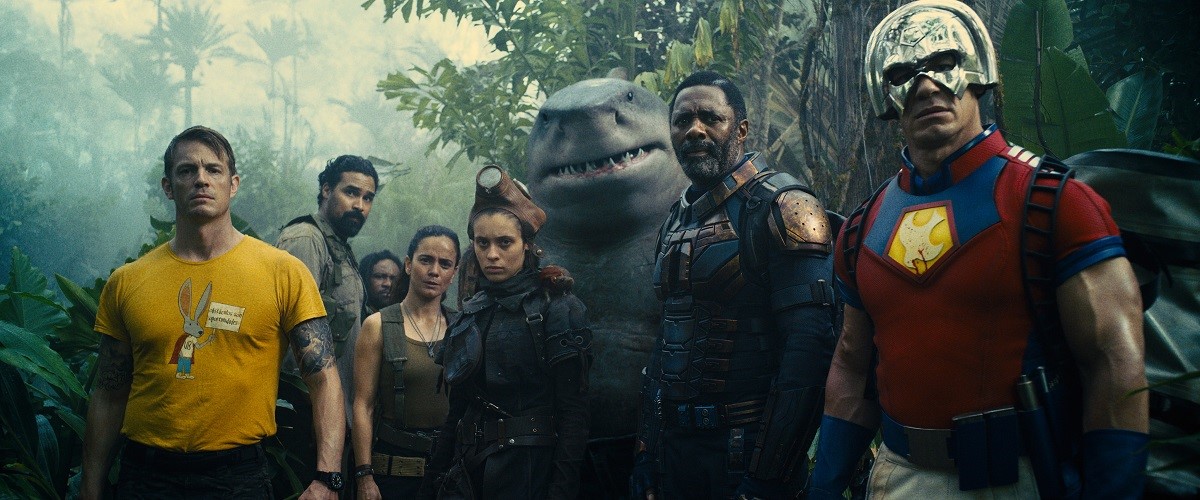
In film, each shot contains a vast amount of expressive audio-visual information that is conveyed instantaneously, such that its various meanings are able to bypass the conscious awareness of its audience[1]. James Gunn effectively draws upon visual language in The Suicide Squad to distinguish his characters as authentic and varied, with personal aesthetics evoking a wide range of filmic genres, styles and traditions. The black carapace of Bloodsport’s armour is paired with a Predator-esque helmet, thereby establishing him within the gritty post-futurism of films such as Bladerunner and Christopher Nolan’s Batman. Conversely, Peacemaker is costumed in the camp style of 1970s comics and wears a chrome helmet that is so impractical as to defy reason. These aesthetic decisions establish the characters as foils, defined primarily in terms of their opposing logics and world-views. The significance of aesthetic technique is also evident in Gunn’s depiction of Rick Flag, whose army uniform in 2016’s Suicide Squad attracted derision as a visual allegory for his conservativism in contrast with his more deviant, leather-clad peers. Costuming Flag in a yellow t-shirt emblazoned with a cartoon rabbit in the 2021 film signifies the character’s newfound insouciance, and speaks to Gunn’s The Suicide Squad representing a less self-serious entry into the genre.
While The Suicide Squad is unique in many respects, it is conventional in exhibiting the politically left ideology that is commonplace within the superhero genre. In The Sky is Falling (2018), Peter Biskind identifies the following characteristics that are apparent in films with an underlying leftist ideology:
- Portrayal of authority, the military and/or the government as brutal and stupid;
- The ‘other’ is viewed with sympathy;
- Differences are valued;
- Society requires saving from itself; and
- The therapeutic model of social control is promoted above coercive control.[2]
In The Suicide Squad, Starro enjoys the status of sympathetic ‘other’ in spite of his explicit monstrousness. Though he destroys the city of Corto Maltese and takes innumerable human hosts by disseminating face-hugging parasites that reduce their victims to empty husks with faces of bloody mulch, Starro departs the narrative with the statement ‘I was happy, floating, staring at the stars’. This implicates the United States Government as the ultimate transgressor for disrupting the course of nature and encourages audience alignment with Starro. Biskind suggests this is typical of the ‘luddite left’ perspective, which promotes the sanctity of nature above culture, particularly condemning the exploitation of nature in service of corporate greed. The Government’s attempted intervention in the Corto Maltese conflicts is framed as imperialist paternalism that is ultimately harmful due to their fundamental ignorance of the culture. The brutality of the United States’ disregard for Corto Maltese is made manifest when their figurehead – Amanda Waller – instructs the Suicide Squad to abandon the nation to Starro’s wrath, prioritising the government’s reputation above the public interest. The internal revolt initiated by the government’s staff is depicted as a necessary means of addressing institutional incompetence and oppression, thereby firmly establishing the leftist ideals of The Suicide Squad through the narrative mechanism of a Marxist revolution.
While the leftist ideology of the MCU and DCEU indicts societal institutions and corporations for their self-interest, these films are ironically produced by the most financially-driven corporations in the modern world, being Warner Brothers and the Walt Disney Company. Martin Scorsese characterises these superhero texts as products rather than cinema, noting that ‘their contents are market-researched, audience sanctioned, vetted and modified until they are ready for consumption’[3]. The mass consumption of such films is driven by rendering characters as broad archetypes that speak to brand as opposed to identity, and narratives that are action-driven and centred around conventional, non-threatening themes that transcend cultural boundaries to amass international and intergenerational appeal. The box office success, licencing agreements with distributors and merchandise profits generated by this widespread appeal serves the financial interests of production companies, thereby perpetuating a formulaic approach to film-making that prioritises consumption above quality or artistic vision.
The profitability of formulaic film production by elite corporations is evident upon analysing the twenty highest-grossing films of all time, which reveals that 85% are franchise films and 65% are produced and distributed by Walt Disney Studios. [4] In particular, Avengers: Endgame’s (2019) position as the second highest grossing film of all time epitomises the profitability of the formulaic approach. As the twenty-second film in the MCU, Endgame represents the apex of franchise sequels with its appeal primarily deriving from the audience’s pre-existing investment in the narrative daisy-chains established by its progenitors. Whilst 15% of the highest grossing films is comprised of original features, these films fall within a homogenous group of production companies that are over-represented throughout the top performers. In circumstances where profit and success are concentrated amongst a minority of elite production companies that produce highly formulaic content, there are few extrinsic incentives for the pursuit of creative expression and cinematic risk.
| Film Franchise | % HG 20 | Production Company/Distributor[5] |
| MCU | 30% | Walt Disney Studios |
| Harry Potter | 5% | Warner Bros. Pictures |
| Disney Sequels | 10% | Walt Disney Studios |
| Disney Remakes | 10% | Walt Disney Studios |
| Star Wars | 10% | Walt Disney Studios |
| Fast and Furious | 10% | Original Film/Universal Pictures |
| Jurassic Park | 10% | Amblin Entertainment/Universal Pictures |
| Original Features | 15% | Titanic – Paramount Pictures & 20th Century Fox Avatar – 20th Century Fox Frozen – Walt Disney Studios |
The critical discourse in relation to the highest grossing films suggests that financial success is not a measure of quality; however, the locales of financial success have and will continue to influence the direction of the film industry. Scorsese proposes this will lead to a ‘steady elimination of risk’ in cinema and the marginalisation of independent film and original features in favour of franchise dominance, noting that franchise films are more appropriately characterised as ‘worldwide audio-visual entertainment’ as opposed to true cinema. Conversely, true cinema is characterised by:
- Genuine risk;
- The film reflects the vision of an individual artist;
- The audience is exposed to something unexpected/new to their experience;
- The complexity of the human condition, in its contradictions, is explored.
Whilst these features are evident in The Suicide Squad, the risk and creative expression reflected therein is increasingly anomalic in the modern film industry and reflects broader social trends away from art that exhibits complexity toward art-substitutes that are motivated by external incentives. The purpose of art is perspective. Art situates us within others perspectives to enable imaginative access to other selves, and is a mechanism for the artist to express their individual vision. Art substitutes such as worldwide audio-visual entertainment are capable of inciting pleasure and gratification; however, they cannot replicate the human subjectivity that constitutes art. The Suicide Squad is an unlikely forebear of artistic integrity and it remains to be determined whether it establishes an ongoing precedent for work that contains risk and merit within the DCEU and cinema more broadly.
[1] Sikov, E. 2020. Film Studies: An Introduction. 2nd Ed. Columbia University Press, New York.
[2] Biskind, P. 2018. ‘The Sky is Falling: How Vampires, Zombies, Androids and Superheroes Made America Great for Extremism’. New Press, New York.
[3] Scorsese, M. 2019. Martin Scorsese: I Said Marvel Movies Aren’t Cinema. Let me Explain. [Online] Available at: https://www.nytimes.com/2019/11/04/opinion/martin-scorsese-marvel.html
[4]IMDB. 2021. Top Lifetime Grosses. [Online] Available at: https://bit.ly/3AkqUJ2
[5] While Marvel and Star Wars films are produced by Marvel Studios and Lucasfilm Ltd respectively, these are merely subsidiaries of Walt Disney Studios and have been noted as such in table 1.
 View Kid